Bar replay, chart replay, market replay
The three names describe the same idea. Bar replay usually means the chart advances one candle at a time. Chart replay is the broader term for any tool that rewinds price. Market replay is often used when the data is tick-level rather than bars. What matters is not the name but the two things every honest implementation does: it hides the future, and it advances in a fixed step.
Why hiding the future is the whole point
On a normal historical chart, you cannot unsee the move that follows. A pullback looks like a buying opportunity because you already know it held. Bar replay removes that knowledge: the chart ends at the current bar, and the next one is genuinely unknown. That is the only way to practise a discretionary decision — and the reason replay is useful even when you have no intention of automating anything.
How a replay session works
- Choose the market and a starting minute in the history.
- Pick the chart timeframe. A 5-minute chart is built from the same underlying bars, so switching timeframe does not change what has happened.
- Choose a step: one minute, one bar, or a fixed window per step, and a speed from 1× to 20×. You can also step forward by hand.
- Place orders and manage the position as if it were live.
- When the session ends, review every order and every trade.
Bar replay vs tick replay
Tick replay advances trade by trade; bar replay advances a candle at a time. Tick data is finer, but it is heavier to store, slower to step through, and usually limited to a shorter history. For intraday futures rules, one-minute bars are enough to decide whether a limit was reached or a stop was crossed — and they are the resolution most brokers’ statements and most published strategies are described in.
What to watch out for
- Indicators that repaint. If an indicator uses data from after the current bar, the replay is lying to you. Check whether higher-timeframe levels appear only after that candle has closed.
- Intrabar assumptions. On a one-minute bar you know the high and the low, not the order they happened in. A stop and a target inside the same bar cannot both be resolved with certainty — any simulator has to pick a rule, and you should know which one.
- Cherry-picked days. Replaying the three most famous sessions proves nothing. The sample has to include ordinary days.
- No record. If you cannot review the orders you placed and cancelled, you are watching charts, not practising.
Try it
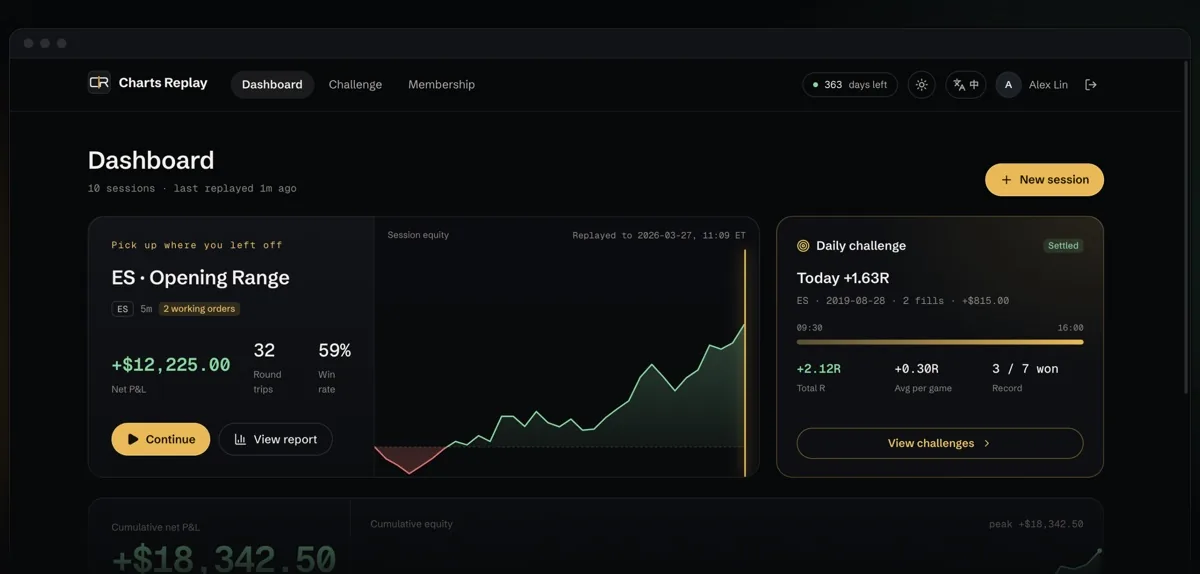
Charts Replay replays ES, NQ and GC futures and BTC/ETH spot, with every order, fill and cancellation saved. Start with chart replay, or take a setup straight into an opening range breakout backtest.