The GC data
- Coverage: January 3, 2016, 18:00 ET to November 1, 2026, 23:59 ET — 3.78 million one-minute bars, full electronic session.
- True traded prices: 55 front-month segments selected by volume (G, J, M, Q, Z), with no spread adjustment. A level from 2016 is a price you could really have worked an order at.
- Checked: every price is a multiple of 0.1, with no duplicate minutes and no broken OHLC.
- Timeframes: 15 timeframes from 1m, 2m, 3m, 5m, 10m, 15m, 30m and 45m to 1h, 2h, 3h, 4h, 1D, 1W and 1M, all built from the same one-minute bars.
- Platform & pricing: Runs in any browser on Mac, Windows or iPad with zero downloads — 7-day free trial (no card required), then $2.99/month (limited-time price, normally $4.99) or $29.90/year.
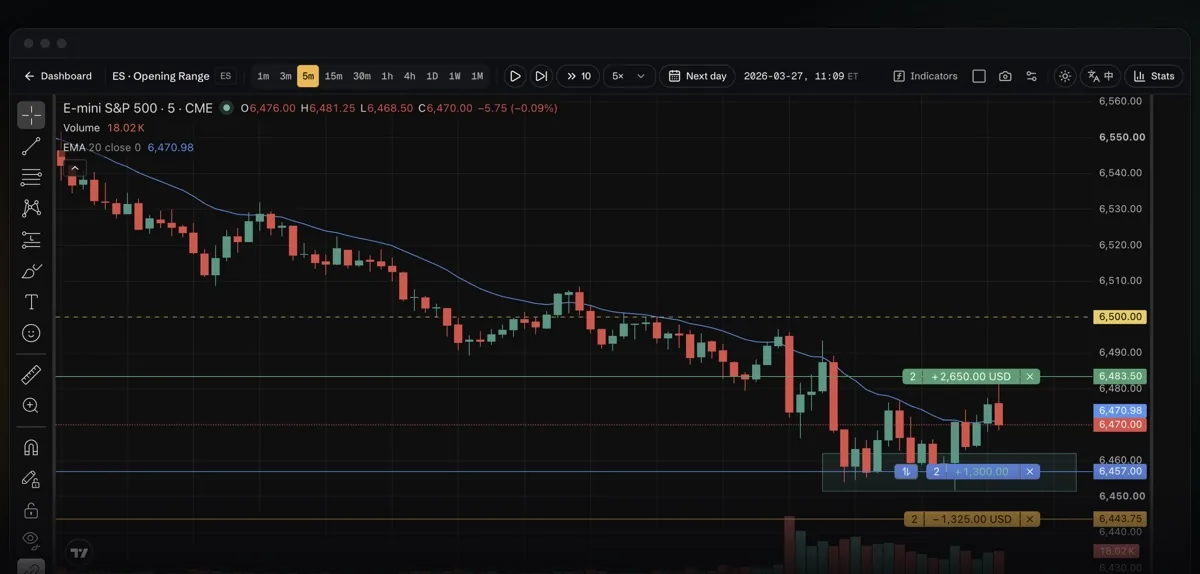
Why true prices matter for gold
Gold trades around round numbers — 1,800, 2,000, 2,500 — and around prior highs and lows. A back-adjusted futures chart shifts the whole history at every roll to hide the gap between contracts, so those levels no longer sit where they did. Any rule that uses a round number, a prior high or an exact limit price ends up filling somewhere else. GC on Charts Replay is not adjusted, so a level gold printed in 2016 is still the same price on the chart.
How the GC series is built
The series is Databento’s continuous GC contract, front month by prior-day volume ranking, split into 55 segments. It rolls at UTC midnight — 19:00 or 20:00 in New York, during the session — rather than at the exchange day boundary, so the daily bar on a roll day is built from two contracts. Historical prices are never re-adjusted; appending new data only adds bars after the last one.
Contract math used in the simulator
| GC (Standard) | MGC (Micro mode) | |
|---|---|---|
| Point value | $100 per point | $10 per point |
| Tick | 0.10 point = $10 | 0.10 point = $1.00 |
| Commission | You set it per session ($2.50/side in daily challenge) | You set it per session ($0.96/side in CR FLEX 50K) |
| Starting balance | You set it per session ($100,000 in daily challenge) | You set it per session ($50,000 in CR FLEX 50K) |
How fills work
- Every one-minute bar is matched before it is drawn, whatever timeframe is on screen — an order placed on a 4-hour chart fills in the minute price actually reached it.
- Limits fill when price reaches them; stops fill when price crosses them.
- Gaps are priced against the bar’s open: a buy limit gapped through fills at the better open, a stop gapped through fills at the worse open plus slippage.
- When several orders trigger in the same bar, stops match before limits.
What you can backtest on GC
- London and New York gold sessions, plus the quieter Asian hours — the full electronic session is included.
- Opening-range and prior-day-level setups, using the built-in price action indicators.
- Time-window models such as the ICT Silver Bullet, using ICT indicators for sessions and liquidity.
- GC is also used in prop firm practice and in the random puzzle pool alongside ES, NQ, BTC and ETH.
What you get back
Each session has a report: net P&L, win rate, profit factor, payoff ratio, maximum drawdown and an equity curve; a trade calendar; every trade with entry, exit, holding time, MAE/MFE and exit reason; and every order, including the ones that never filled.