Two different questions
| Bar replay | Automated backtest | |
|---|---|---|
| Sample | One session at a time | Hundreds or thousands of days |
| Decision | Made by you, in real time | Made by code, identically every time |
| Answers | Would I take this trade? How did I manage it? | Does this rule have an edge, and how big? |
| Weakness | Small sample, hard to repeat | Overfitting, look-ahead bias, unrealistic fill assumptions |
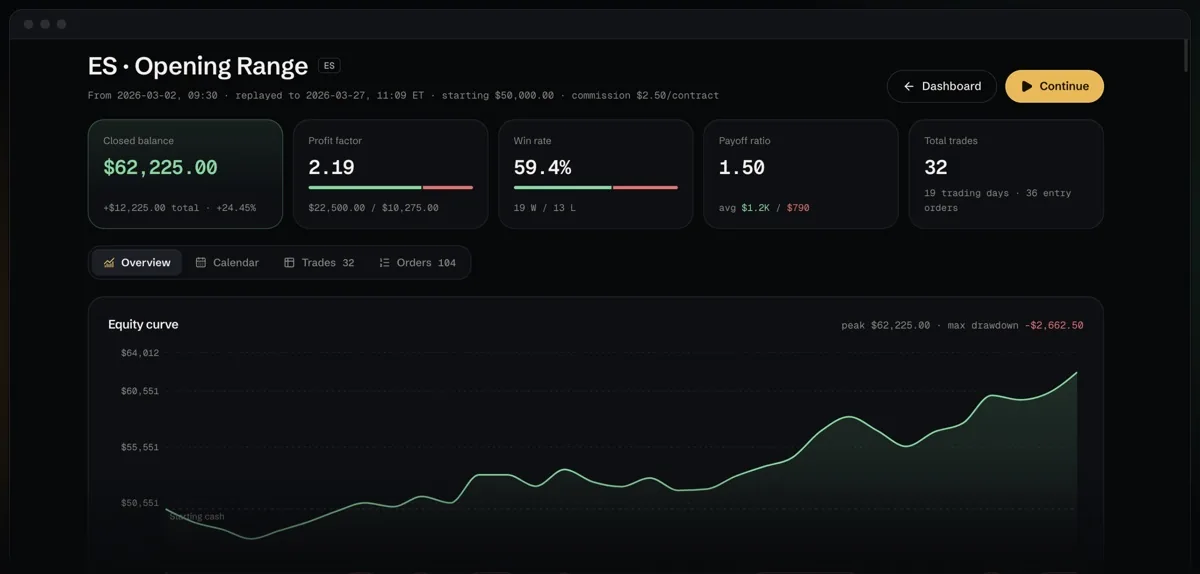
What manual replay is good for
- Discovering rules you can actually follow, including the parts you would never write down on the first pass.
- Rehearsing execution: where the stop goes, how you scale, what you do after two losses.
- Reviewing decisions rather than outcomes — the order you cancelled often explains more than the one you took.
What automated backtesting is good for
- Sample size. A rule that looks good on 20 days can disappear across 500.
- Parameter sensitivity: does the result survive a small change in stop distance or session window?
- Removing the operator. Code takes every signal, including the ones you would have skipped on a bad morning.
Where each one misleads
Replay misleads when the sample is too small or too famous. Backtests mislead when the rules were written after seeing the data, when an indicator reads the current bar’s close before it exists, or when the fill model assumes a limit filled because the bar’s low touched it and ignores queue position. Neither method fixes the other’s bias; they expose different ones.
Use them in order
- Replay 20–30 sessions to write the rules down precisely: entry, stop, target, session window, what invalidates the trade.
- Automate the written rule and run it across the full history.
- Return to replay for the outliers — the trades the backtest handled differently from how you would have.
- Change one rule at a time, then repeat.
Where Charts Replay fits
Charts Replay is the manual half: one-minute replay, real resting orders and a saved record, with no scripting. Use it to build the rule and to review the trades a backtest cannot explain. If you want the automated half, the rules you write here are specific enough to hand to any backtesting library.