The rules most evaluations share
| Rule | What it usually means | How traders fail it |
|---|---|---|
| Profit target | A fixed gain, often 6–10% of the account | Oversizing to get there quickly |
| Maximum drawdown | A floor on equity, either fixed or trailing the high-water mark | One bad day near the floor; letting a winner run without protecting it |
| Daily loss limit | A cap on the loss in a single day | Trading after the limit is hit or before it is measured |
| Consistency rule | No single day may be too large a share of total profit | One outlier day carrying the whole evaluation |
| Minimum days | A number of trading days before a payout or pass | Passing the target early and then overtrading |
| News and close rules | No positions around scheduled events or the daily close | Carrying a position through the close |
The drawdown rule is the one that decides it
A profit target is a destination; a drawdown limit is the road you have to stay on. A trailing floor moves up with your high-water mark, so a profitable day raises the level you can fall back to. That is why the common failure is not “I never made the target” but “I gave back the good day”. Size every trade from the distance to the floor, not from the distance to the target.
Rehearse the numbers, not the slogan
- Set the session balance and commission to match the evaluation, then keep them fixed for the whole rehearsal.
- Put a stop on every entry and size it so the dollar risk is identical each time. If the size changes with your mood, the rehearsal is measuring mood.
- Score yourself in R, not dollars: net P&L ÷ total risk taken. It makes a good day on NQ and a good day on ES comparable.
- For a trailing floor or a daily loss limit, write the rule on paper and check it after every session — the simulator will not enforce a firm’s private rulebook for you.
How Charts Replay helps
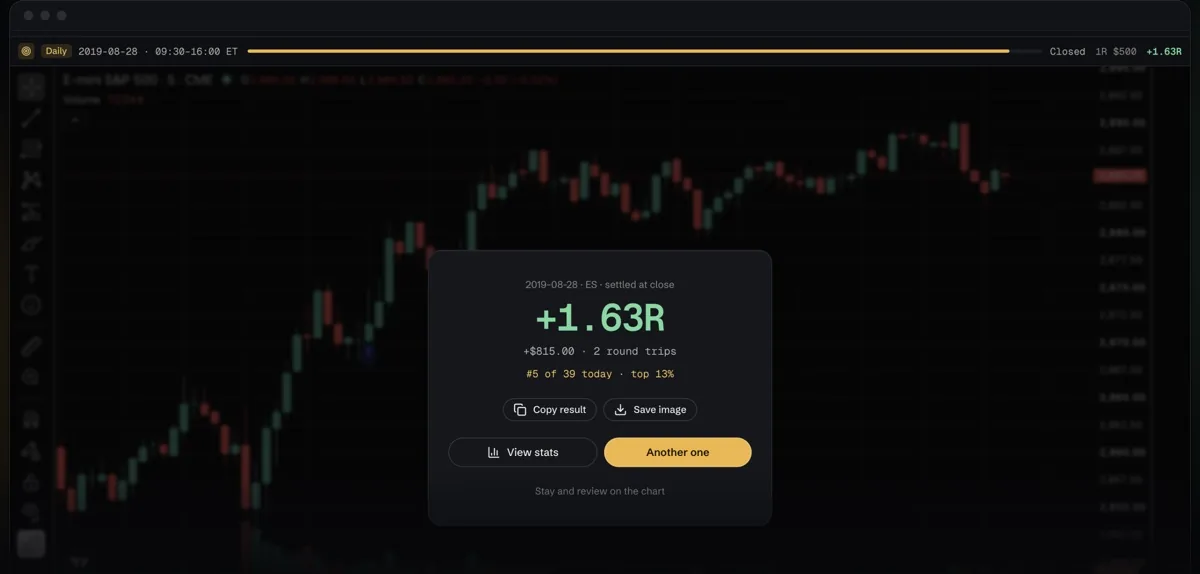
The daily challenge fixes one trading day, a $100,000 account, a stop on every entry and risk capped at your balance, then scores the result in R. Free replay lets you set your own balance and commission and drill a fixed window every day. The app also runs its own evaluation-style account with a fixed target, a trailing floor and a consistency rule, and includes a built-in Monte Carlo simulator so you can stress-test your pass odds before risking a fee.
A rehearsal routine
- Pick one rule for the week — for example, never risk more than 0.5% of the account on one trade.
- Replay five sessions at the same time of day, on the same contract.
- Record the rule violations, not just the P&L.
- At the end of the week, change one thing and repeat.
Charts Replay is not a prop firm and is not affiliated with any. It does not offer funded accounts, hold funds or execute real trades. Rules differ by firm; read yours and rehearse against those numbers.